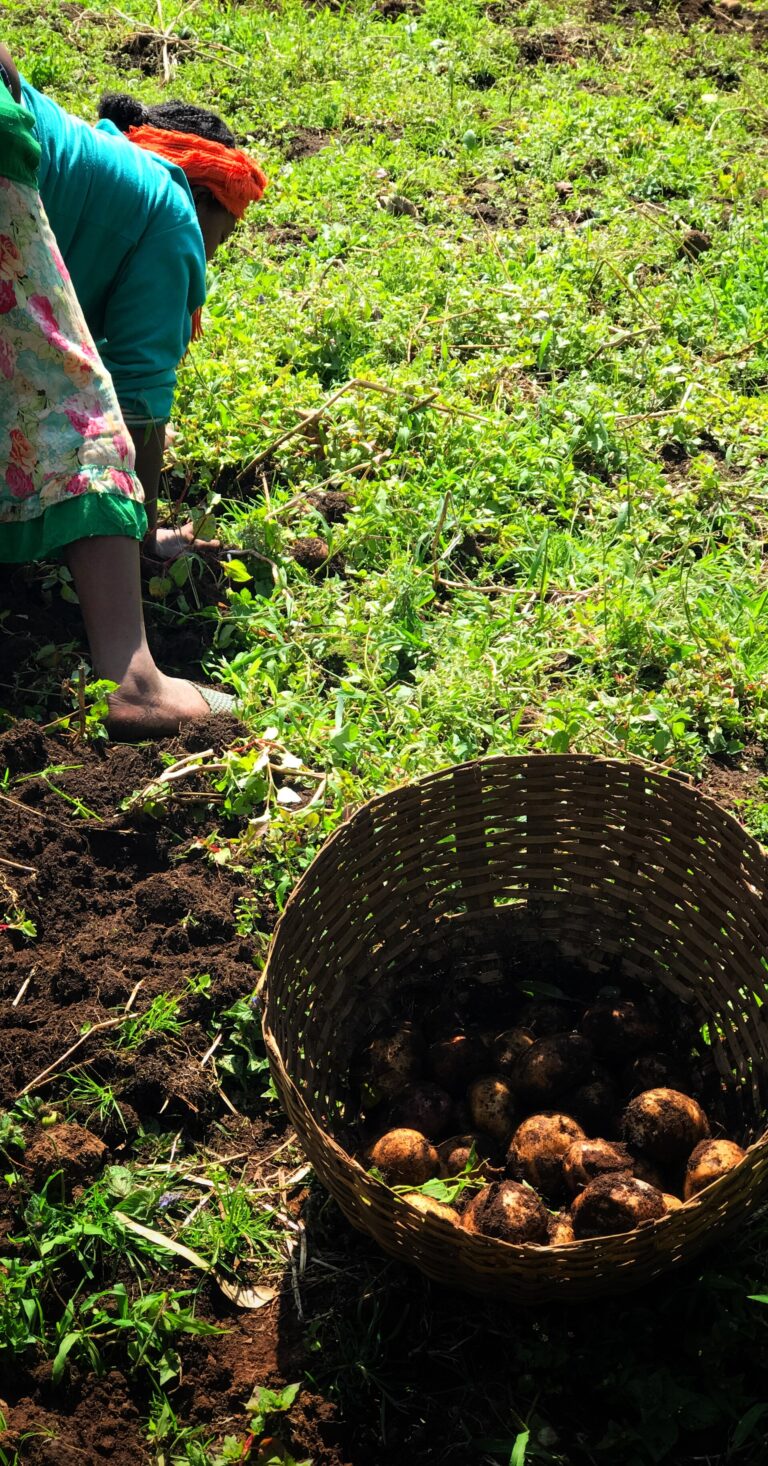
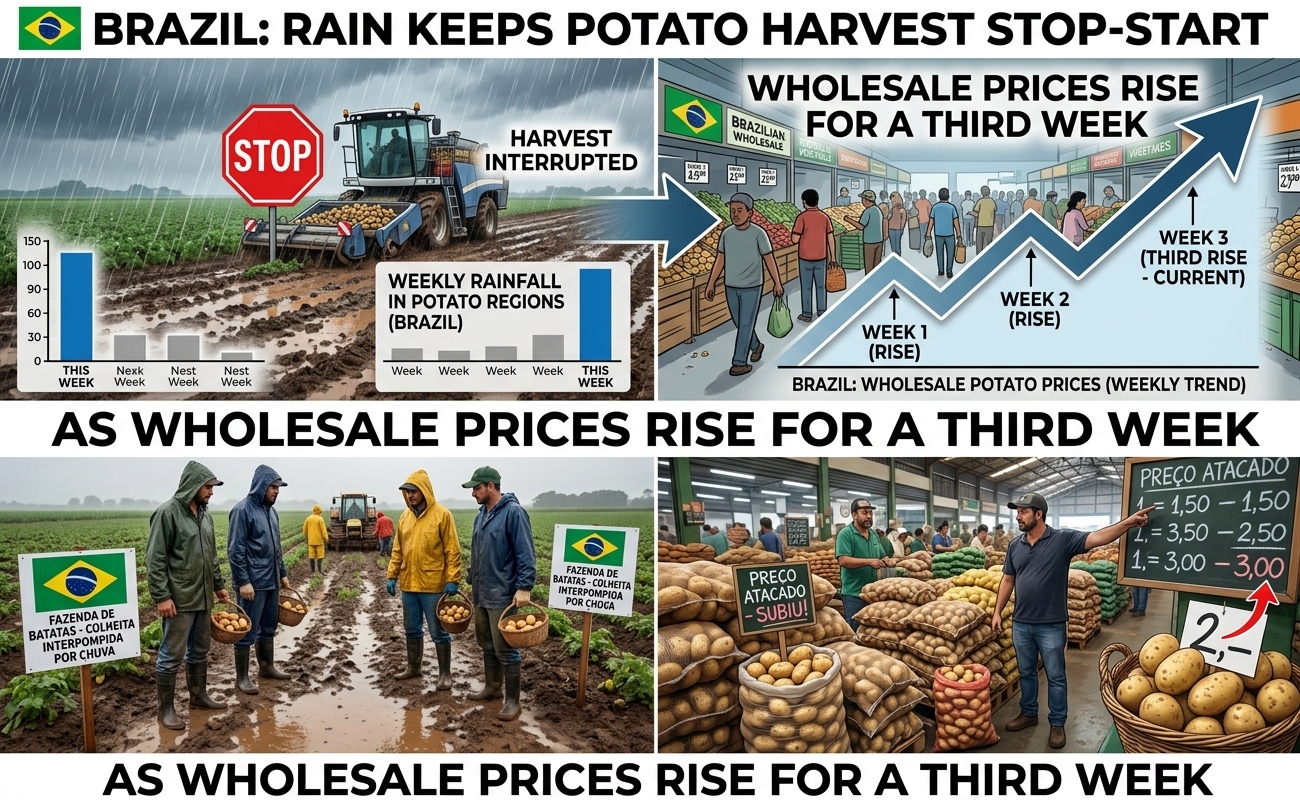
Brezil: lapli anpeche rekòt pòmdetè rekòmanse pandan pri an gwo yo ap monte pou yon twazyèm semèn.
Takeaways kle yo
- 3rd consecutive week of rising wholesale potato prices
- 7.9% weekly gain in Rio de Janeiro against 0.4% in Sao Paulo
- 107.50 reais per 25 kg bag in Rio, the steepest rise
- 4.0% rise in Belo Horizonte, to 94.72 reais per bag
Poukisa li enpòtan
- Pou kiltivatè yo
- Lifting stopped outright in south-western Sao Paulo and slowed on saturated soils in Vargem Grande do Sul. If you can access fields, the delivery window is where the premium sits, and it is Friday-shaped.
- Pou procesè yo
- Three weeks of rising wholesale prices driven by access to fields rather than crop size means raw-material cost should ease with the weather. Contracting against this week’s peak would lock in a rain premium.
- Pou komèsan yo
- The spread between markets is the trade this week: Rio up 7.9 percent while Sao Paulo moved 0.4 percent. That gap comes from delivery interruption, not demand, so it closes as soon as fields dry.
Rezime 60 segonn
Wet weather in south-east Brazil disrupted potato lifting again between 7 and 11 September, pushing wholesale prices up for a third consecutive week. The gains were much smaller than the previous week and uneven between markets. On the Hortifruti/Cepea weekly survey, top-grade Agata potatoes averaged 98.42 reais per 25 kg bag in Sao Paulo, virtually flat at plus 0.4 percent; 94.72 in Belo Horizonte, up 4.0 percent; and 107.50 in Rio de Janeiro, up 7.9 percent and the steepest of the three. The week split in two: drier conditions early on let harvesting pick up and prices held steady to Wednesday, then heavier rain on Thursday and Friday across several growing areas made fields hard to access and cut deliveries, with the sharpest increases coming on Friday. In south-western Sao Paulo state, rain halted lifting altogether; in Vargem Grande do Sul saturated soils slowed it considerably.
Wet weather in Brazil’s south-east once again disrupted potato lifting between 7 and 11 September, pushing wholesale prices higher for the third consecutive week. The latest gains were far smaller than the previous week’s surge, however, and uneven across markets: prices in São Paulo were virtually flat, while Rio de Janeiro recorded the steepest rise.
Pri Wholesale
According to the weekly survey by Hortifrúti/Cepea, the horticultural market research team at the Center for Advanced Studies on Applied Economics (University of São Paulo, ESALQ campus), average prices for top-grade (espesyal) Ágata potatoes were as follows:
| Mache an gwo | 31 Aug–4 Sep (BRL/25 kg bag) | 7–11 Sep (BRL/25 kg bag) | Weekly change* | Per kg* |
|---|---|---|---|---|
| São Paulo | 98.00 | 98.42 | + 0.4% | ≈ BRL 3.94 |
| Belo horizonte | 91.12 | 94.72 | + 4.0% | ≈ BRL 3.79 |
| Rio de Janeiro | 99.64 | 107.50 | + 7.9% | ≈ BRL 4.30 |
*Calculated by the editors from Cepea’s weekly averages. Some secondary reports of the same data give weekly changes that do not match the published prices; the figures above are derived directly from the price series.
Jou lasemèn. Dezabòne ak yon sèl klike.
A week of two halves
Drier conditions early in the week allowed harvesting to pick up, and prices held broadly steady until Wednesday 9 September. Heavier rain returned on Thursday and Friday across several growing areas, making fields difficult to access and cutting deliveries to wholesale markets. The sharpest price increases came on Friday.
Conditions varied by region. In south-western São Paulo state, rain on Wednesday and Thursday halted lifting altogether. In Vargem Grande do Sul, one of the state’s main potato-producing districts, some harvesting went ahead on Thursday, but saturated soils slowed progress considerably.
Brazilian market analysts describe this pattern as a mercado de chuva, or “rain market”: prices are driven not by a shortfall in the crop itself but by temporary interruptions to harvesting, which tighten supply for a few days at a time and can reverse just as quickly.
Three weeks in context
The week before, from 31 August to 4 September, prices jumped by 46.2% in São Paulo, 39.8% in Belo Horizonte and 28.9% in Rio de Janeiro after rain in Vargem Grande do Sul and southern Minas Gerais disrupted harvesting from 1 September. Cepea reported that tuber quality nonetheless remained generally good.
On the editors’ calculations, prices have risen by roughly 47% in São Paulo, 45% in Belo Horizonte and 39% in Rio de Janeiro over the past two weeks. Measured against early August (3–7 August), when intensive harvesting of the winter crop weighed on the market and averages stood at BRL 60.98 in São Paulo, BRL 59.03 in Belo Horizonte and BRL 55.85 in Rio de Janeiro, current levels are around 61%, 60% and 92% higher respectively.
The rally is unfolding at the height of the safra das secas, Brazil’s dry-season (winter) crop, when volumes in the field are ample. That leaves prices highly sensitive to the weather rather than to underlying availability. Late July offered a reminder: a brief rain-driven rise in southern Minas Gerais and Vargem Grande do Sul faded as soon as drier conditions returned.
pespektiv
Cepea expects further rain in the coming week to keep restricting harvesting, which should support prices in the short term. A potential counterweight is Cristalina in Goiás state, where the harvest is expected to peak in September, with around 80% of the crop marketed by the end of the month. For now, the weather in the south-eastern growing regions remains the decisive factor for price direction.
Source: Hortifrúti/Cepea (ESALQ/USP). Calculations by the editors.
Rezime Mondyal sou Pòmdetè
Senk pi gwo istwa yo, pri yo, alèt maladi yo ak evènman yo. Maten jou lasemèn yo, pa gen piblisite.
Ki sa kap vini an
Prices are tied to field access rather than crop size, so the article gives no forecast beyond the weather. No indication is given of when lifting resumes in the affected districts.
Sous
- Weekly survey by Hortifruti/Cepea, the horticultural market research team at the Center for Advanced Studies on Applied Economics, University of Sao Paulo (ESALQ). The weekly percentage changes and per-kilogram figures were calculated by the editors directly from the published price series - the article notes that some secondary reports of the same data give changes that do not match the published prices.
Lyen nan materyèl sa a
- peyi
- Brezil
Istwa ki gen rapò
Peyi Ba: Kiltivatè grenn Friesland kenbe Annabelle pwòp pandan senk jenerasyon san minitubèr.
Pri pòmdetè mondyal yo, semèn 39: Ewòp ap fèm sou yon rekòt kout pandan Azi rete twòp.