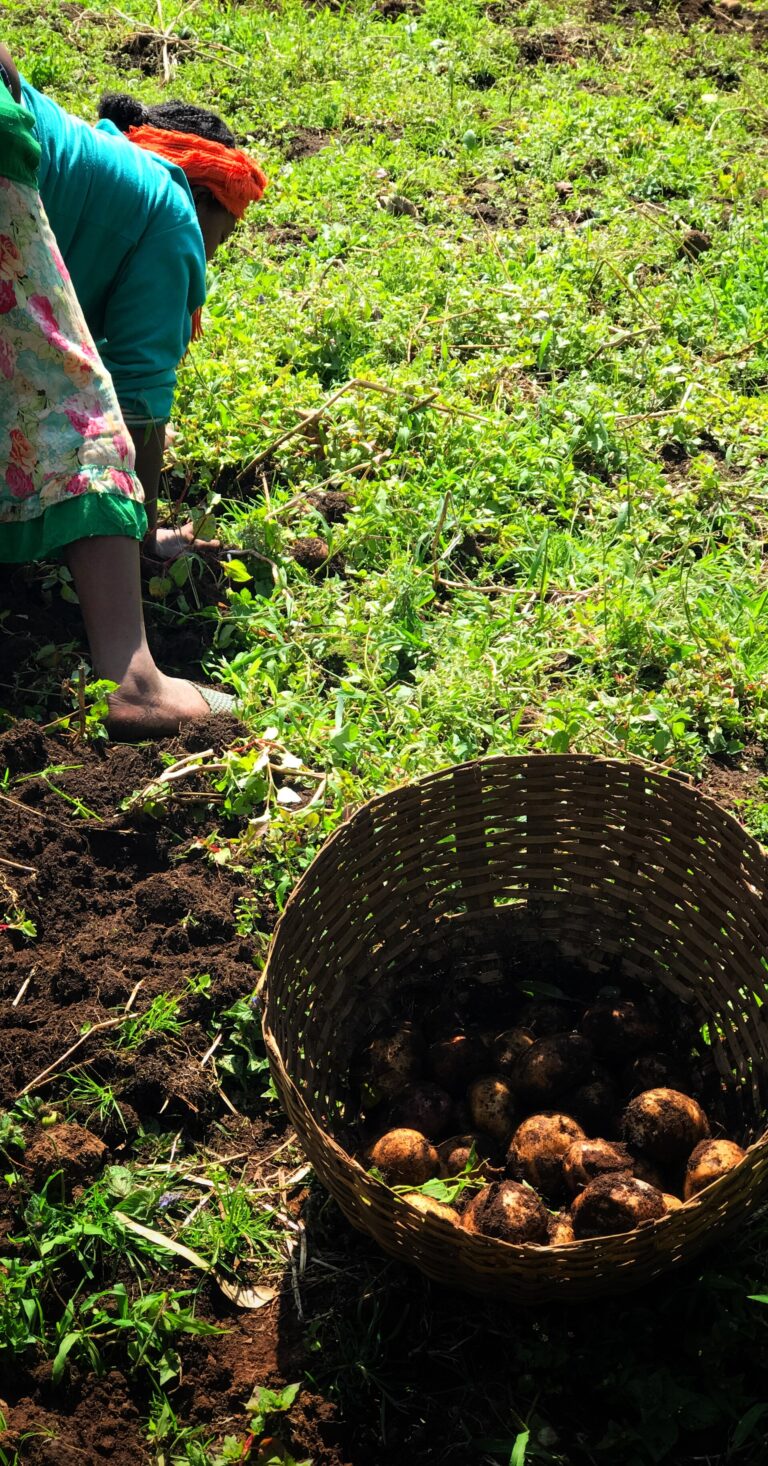
Pwoblèm grenn nan peyi Zend: Poukisa dezyèm pi gwo pwodiktè pòmdetè nan mond lan rekòlte mwatye kantite pa ekta
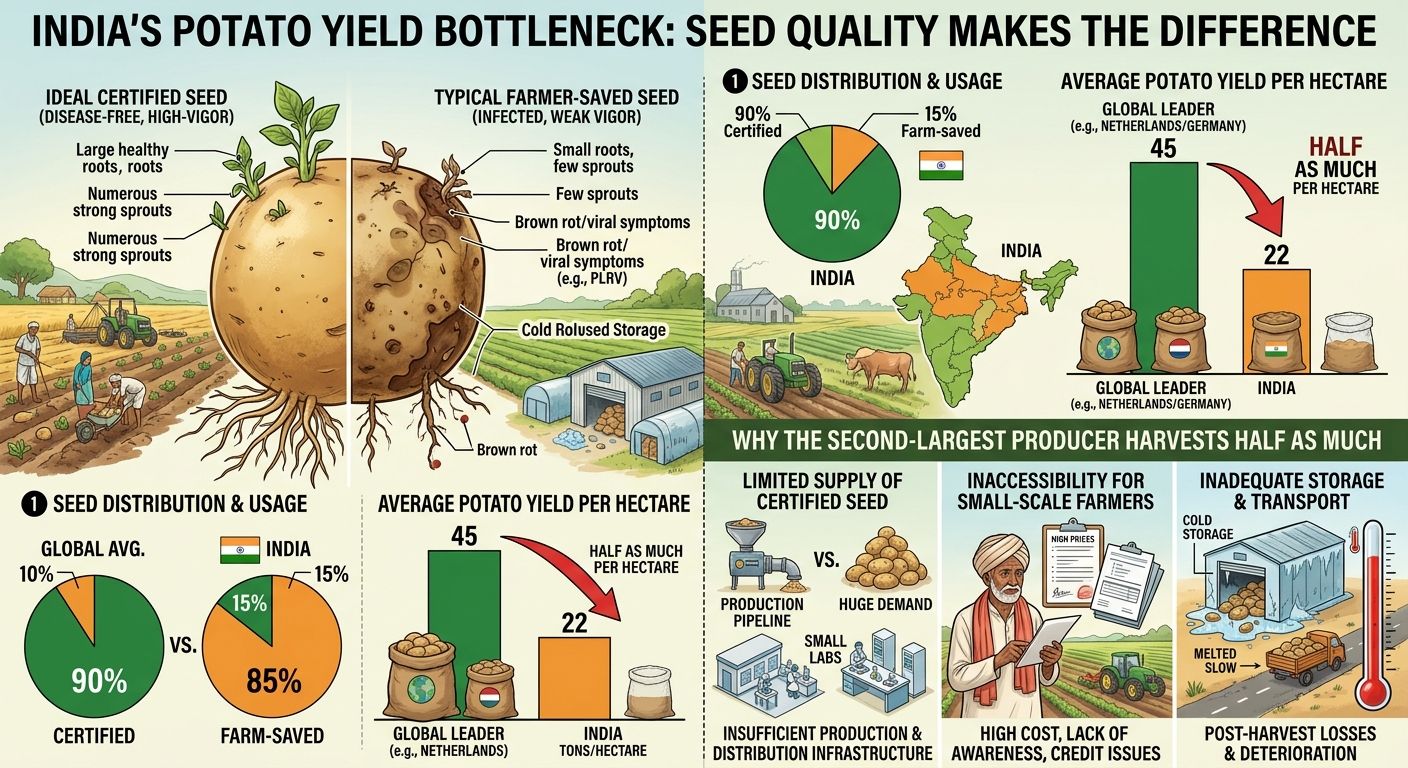
Takeaways kle yo
- 58.6 mln tonnes is India's annual potato production
- 24-25 t/ha is India's real yield, against 28-30 claimed
- 53.5 t/ha in the Netherlands, the highest in 25 years
- 46-48% of Dutch and US levels is where India sits
Poukisa li enpòtan
- Pou kiltivatè yo
- If you are benchmarking your own yield, use 24-25 t/ha as the national reference, not 28-30 - the higher figure describes Gujarat-style contract farming for processing, not the average rabi crop.
- Pou procesè yo
- Contract-farmed processing regions already run near 29.7 t/ha while the national average sits at 24-25. The upside from seed replacement is in the gap between those two, and that is where sourcing programmes pay.
- Pou founisè
- Seed sellers have a real argument here, but check the numbers you quote: the widely circulated 28-30 t/ha figure overstates India’s average and understates the opportunity you are selling against.
- Pou envestisè yo
- Two caveats before sizing the gap: the Dutch 53.5 t/ha is gross yield in an exceptional season, and India’s crop is grown largely in the short winter window - so the ratio is not a like-for-like agronomic comparison.
Rezime 60 segonn
India grows about 58.6 million tonnes of potatoes a year on the ministry’s final 2024-25 estimate, second only to China, yet a hectare there yields roughly half what the United States or the Netherlands get. A column by the chief executive of HyFarm argues the cause is the seed tuber rather than soil or climate. The gap is real, but the column’s own numbers understate it. It puts India at 28-30 t/ha; the last fully confirmed official figure is 24.55 t/ha for 2018-19, and estimates drawing on ICAR-CPRI and ministry data put the mid-2020s at 24-25 t/ha. The 28-30 range is closer to the best states - Gujarat, the centre of processing contract farming, averages about 29.7. The benchmarks have also risen: the US set a 2025 record near 51.6 t/ha and Dutch gross yield reached 53.5. Against the real national average India sits at 46-48 percent of those levels, not 55-58.
A HyFarm opinion piece blames low seed replacement for India’s yield gap. The gap itself is real — but it is wider than the company suggests, and its seed figure is hard to confirm.
India grows roughly 58.6 million tonnes of potatoes a year, according to the Department of Agriculture and Farmers’ Welfare’s final estimate for 2024-25, placing it second only to China. Yet each Indian hectare produces around half of what growers in the United States or the Netherlands achieve. In a column published by PotatoPro on 13–14 August 2026, the chief executive of HyFarm — the agribusiness arm of Indian frozen potato processor HyFun Foods — argues that the root of the problem lies not in soil or climate, but in the seed tuber.
How big is the yield gap?
The column puts India’s average yield at 28–30 t/ha. That figure appears to be too high. The last fully confirmed official national figure is 24.55 t/ha (2018-19), and IndianPotato.com, drawing on ICAR-Central Potato Research Institute (CPRI) and ministry data, estimates that national yields in the mid-2020s remain at around 24–25 t/ha. Because the ministry’s 2024-25 final estimates do not include a potato-specific area, the current national yield remains an approximation. A yield of 28–30 t/ha is closer to India’s best-performing states: Gujarat, the centre of contract farming for processing-grade potatoes, averages about 29.7 t/ha.
Jou lasemèn. Dezabòne ak yon sèl klike.
The benchmarks cited in the column have also moved higher:
- Etazini: USDA NASS reports a record 2025 average of 460–461 hundredweight per acre, equivalent to about 51.6 t/ha.
- Netherlands: preliminary Statistics Netherlands (CBS) data show a gross yield of 53.5 t/ha for ware and processing potatoes in 2025 — the highest in 25 years and almost a quarter above 2024.
Measured against India’s actual national average, the “half” claim holds: Indian yields are 46–48% of 2025 Dutch and US levels. On the column’s own figure, the ratio would be closer to 55–58%.
Two caveats apply. The Dutch figure is gross yield in an exceptional season, and India’s crop is grown largely in the short winter (rabi) window on the Indo-Gangetic plains — so part of the gap reflects agro-climatic realities that better seed alone cannot close.
Seed replacement: a disputed number
The column’s central argument is a low seed replacement rate (SRR) — the share of planting material that comes from quality-assured seed, either state-certified or sold under a producer’s “truthful label” (TL) declaration, rather than tubers saved on farm. HyFarm estimates India’s SRR at 25–30%, although the column does not say how this figure was derived.
Independent confirmation proved elusive, and the scientific literature paints a bleaker picture. According to CPRI researchers, the institute supplies about 2,400 tonnes of breeder seed to states each year. Even if this were multiplied through all three prescribed generations (Foundation 1, Foundation 2 and certified), it would yield only around 0.5 million tonnes of certified seed — roughly 10% of national demand, estimated at 5.4–6.4 million tonnes at planting rates of 2.5–3.5 t/ha. In practice, the same researchers note, states rarely complete the full multiplication chain. Indian literature cites 25% as a dezirab SRR for potato, with actual rates described as well below it.
The discrepancy may be methodological. HyFarm’s estimate probably includes TL seed from private companies and minitubers produced through tissue culture and aeroponics, which fall outside the state certification chain. The National Academy of Agricultural Sciences (NAAS) adds a further complication: many small farmers buy seed every season, giving a nominal replacement rate close to 100% — but with no institutional quality control, degenerated produce is often sold to them as seed.
The stakes are considerable. Seed accounts for between one-third and one-half of the cost of growing potatoes in India, according to various estimates.
HyFarm’s prescription
The column calls for India to move beyond simple seed distribution towards an integrated system linking breeding, multiplication, agronomic advice and market demand. Its key elements are:
- market-aligned variety selection, matched to local agro-climatic conditions and to demand from frozen-product manufacturers, quick-service restaurants and modern retail;
- contract-based supply, reducing farmers’ exposure to volatile prices at mandis — India’s regulated wholesale agricultural markets;
- digital advisory services covering crop monitoring, nutrient management and disease diagnostics throughout the season;
- trasabilite of seed origin and quality.
Readers should note that HyFarm has a direct commercial interest in this agenda. The company runs contract seed multiplication and procures raw potatoes for HyFun’s processing plants. In December 2025 it signed a strategic partnership with the International Potato Center (CIP), and it aims to work with 30,000 farmers and procure one million tonnes of potatoes a year by 2028–29. The piece is best read as an industry position rather than independent analysis.
Why it matters for the global trade
India processes only around 7% of its potato crop, compared with 70–80% in many industrialised countries, according to IndianPotato.com citing the Ministry of Food Processing Industries. Expanding processing capacity — and India’s growing exports of frozen fries — depends on a consistent supply of tubers with the right dry matter, shape and fry colour. That consistency starts with healthy seed of the right variety, which makes India’s seed system one of the most significant variables in the long-term outlook for a market of nearly 60 million tonnes.
Sous
- PotatoPro / HyFarm Foods — India’s Potato Future Starts With Better Seed (13–14.08.2026): https://www.potatopro.com/news/2026/india%E2%80%99s-potato-future-starts-better-seed-building-stronger-seed-ecosystem-farmers
- IndianPotato.com — Potato Production in India: Area, Production & Yield Trends 1950–2025 (DA&FW, ICAR-CPRI and FAOSTAT data): https://indianpotato.com/potato-production-in-india/
- USDA ERS — Vegetables and Pulses Outlook, December 2025 (VGS-377): https://vegetablegrowersnews.com/wp-content/uploads/2025/12/VGS-377.pdf
- FreshPlaza / Mintec (Expana) — U.S. potato production down 2% in 2025 (USDA Crop Production 2025 Summary): https://www.freshplaza.com/north-america/article/9803678/u-s-potato-production-down-2-in-2025/
- CBS — Hoogste opbrengst consumptieaardappelen en zaaiuien in 25 jaar: https://www.cbs.nl/nl-nl/nieuws/2025/44/hoogste-opbrengst-consumptieaardappelen-en-zaaiuien-in-25-jaar
- Frontiers in Agronomy (2022) — review of India’s potato seed system (ICAR-CPRI): https://www.frontiersin.org/journals/agronomy/articles/10.3389/fagro.2022.956667/xml
- NAAS — Strategy Paper 14: Innovations in Potato Seed Production: https://naas.org.in/spapers/Strategy%20Paper%20No.%2014.pdf
- Krishisewa — Factors influencing seed potato quality in India: https://www.krishisewa.com/seed-production/1553-factors-influencing-seed-potato-quality-india.html
- PotatoPro — International Potato Center and HyFarm form strategic partnership (12.2025): https://www.potatopro.com/news/2025/international-potato-center-and-hyfarm-form-strategic-partnership-advance-processing
- PotatoPro — HyFarm appoints Soundararadjane S as CEO (04.2024): https://www.potatopro.com/node/157625
Rezime Mondyal sou Pòmdetè
Senk pi gwo istwa yo, pri yo, alèt maladi yo ak evènman yo. Maten jou lasemèn yo, pa gen piblisite.
Ki sa kap vini an
The ministry’s 2024-25 final estimates give no potato-specific area, so the current national yield stays an approximation until that is published. The article does not say when a confirmed figure is due.
Sous
- India production: Department of Agriculture and Farmers’ Welfare final estimate 2024-25. Yield estimates: IndianPotato.com drawing on ICAR-Central Potato Research Institute and ministry data. Benchmarks: USDA NASS (2025 record) and preliminary Statistics Netherlands data. The claim under examination is an opinion column by the chief executive of HyFarm, the agribusiness arm of frozen potato processor HyFun Foods, published by PotatoPro on 13-14 August 2026 - a company with a commercial interest in seed replacement.
Lyen nan materyèl sa a
- peyi
- peyi Zend
Istwa ki gen rapò
Peyi Ba: Kiltivatè grenn Friesland kenbe Annabelle pwòp pandan senk jenerasyon san minitubèr.
Pri pòmdetè mondyal yo, semèn 39: Ewòp ap fèm sou yon rekòt kout pandan Azi rete twòp.